

Daniel Mendoza
Daniel Mendoza was the first Jewish prize fighter to become Champion of England from 1792 to 1795. Mendoza stood but 5’7”, but he was a scrapper. Weighing in a 11.5 stone (160 pounds), he was billed as “Mendoza the Jew.” Mendoza was the only middleweight boxer to win the Heavyweight Championship of the World.
It was Mendoza who brought changes to boxing. Before he became popular, men simply stood still and slugged it out. Mendoza introduced the idea of “defense.” Many criticized Mendoza’s tactics, but soon all boxers were using the techniques. He opened his own boxing academy in 1789, which was known as the Mendoza School or the Jewish School. Mendoza also published The Art of Boxing, a book that described his techniques.
Mendoza’s first win came over an opponent known as Harry the Coalheaver, whom he beat in 40 rounds. In a 1787 professional fight, Mendoza won both the bout and the patronage of the Prince of Wales (later George IV). Mendoza was the first Jew to have an audience with England’s King George III, which both elevated the Jew in London’s population, but also a vicious tide of anti-Semitism.
From 29 March 1787 edition of The Times, we see a bit of the secrecy behind the English Sport of Boxing. Generally, only a few knew of the site for a match until the last moment. Prize fights were against the law. Most of the clergy and many of the middle class thought the bare knuckles bouts brutal. That being said, the brutality did not keep the throngs from enjoying the matches. “The boxing match between Martin the Bath Butcher, and Mendoza the Jew, which has been the subject of every blackguard’s conversation for some days, was put a stop to on Tuesday, by the prudent and praise-worthy interference of the civil poser. The parties met on Ealing Common, attended by a great concourse of people (among whom was the Prince – whether accidental or otherwise, we know not – we may, however, reasonably suppose the former – and some other personages of note) when a Justice of the Peace, and a posse comitatus, assisted by a party of the Light Dragoons, made their appearance, and prevented the decision of the combat. In justice to the high personage, whose name we are sorry to mention on this occasion, he was the first to shew respect to the civil authority, by retiring with his party, as soon as the Magistrate made his appearance. The riot act was read, and the mob, in number perhaps ten thousand, dispersed quietly.”
The fight was rescheduled for Barnet Racegroun on 17 April. The crowd numbered some 5000. Mendoza easily defeated Martin in 30 minutes. He won a prize of £500 from the Prince.
In 1788, 1789, and 1790, Mendoza fought storied matches against Richard Humphries, Mendoza’s mentor. He lost the first bout in 29 rounds, but managed to win the other two in 52 and 15 rounds, respectively. The 1789 match was the first time spectators were charged an entry payment to a sporting event. The fights were hyped by a series of combative letters in the press between Humphries and Mendoza.
Mendoza laid claim to the English Championship when Benjamin Brain retired in 1791, but Bill Warr challenged Mendoza’s claim. The two met in Croydon in May 1792. Mendoza’s claim to the title prevailed in 23 rounds. The two met again in 1794. Mendoza dispensed with Warr in a little over a quarter hour.

Gentleman John Jackson
In 1795, Mendoza fought “Gentleman” John Jackson for the championship at Hornchurch in Essex. Jackson was five years younger, 4 inches taller, and 3 stone (42 pounds) heavier. Jackson won in nine rounds. Reportedly, Jackson caught Mendoza long hair, holding Mendoza in place where Jackson could pummel him into submission in ten minutes. Jackson used the win to propel him into Society. Jackson’s Rooms opened at 13 Bond Street, along with the Fives Court off Jermyn Street, where public sparring took place.
Born in Aldgate in July 1764, Mendoza, a descendant of Spanish Marranos (Jews coerced into conversion to Christianity) who had lived in London for nearly a century, became such a popular figure in England that songs were written about him, and his name appeared in scripts of numerous plays. His personal appearances would fill theaters, portraits of him and his fights were popular subjects for artists, and commemorative medals were struck in his honor.
At age 13, he was apprenticed to a glasscutter, but he fought with the employer’s son and was forced from the position. Later, he apprenticed to a Jewish greengrocer and still later to a tea dealer. His fortune rested in his fists.
In his 72 years, Mendoza made and spent a fortune. His memoirs were finally published in 1818. After his glory days, he spent time as a pub owner, teaching boxing, and even was hired by the theatre manager John Philip Kemble in an attempt to suppress the Old Price Riots; the resulting poor publicity probably cost Mendoza much of his popular support, as he was seen to be fighting on the side of the privileged. He even spent time in King’s Bench prison for his debts.
Mendoza made his last public appearance as a boxer in 1820 at Banstead Downs in a grudge match against Tom Owen; he was defeated after 12 rounds. He died on 3 September 1836. By then, the thrill of the boxing ring had waned. Mendoza left his family of 11 children in poverty. One of Mendoza’s descendants, Rufus Daniel Issacs, became Lord Chief Justice and 1st Marquess of Reading.

Peter Sellers
Another of Mendoza’s descendants, the actor Peter Sellers of Pink Panther fame, bears a resemblance to his great-great-grandfather. Perhaps, Sellers used some of the lessons he learned from his relative in those zany scenes of Cato attacking Inspector Clouseau. A print of Mendoza fighting Humphries can be seen on the wall of Clouseau’s office in the films.
Mendoza features as a character in Rodney Stone, a Gothic mystery novel by Sir Arthur Conan Doyle, and one of his fights is mentioned in the 1934 The Scarlet Pimpernel film. A play about Mendoza, “The Punishing Blow” by Randy Cohen debuted in 2009.
Daniel Mendoza was one of the inaugural group elected in 1954 to the Boxing Hall of Fame and of the inaugural class of the International Boxing Hall of Fame in 1990.
Also, there was a 2013 film regarding his life. “Nan-Tom Film Arts International [brought] to the screen the amazing and inspirational story of Daniel Mendoza in a compelling documentary tour de force: Mendoza the Magnificent: The Man Who Revolutionized Boxing. Through the dark streets, gaming parlors, and treacherous social circles of Regency London, our guide will be the opinionated Mr. Pierce Egan. In the 1790s, this charismatic young sportswriter was boxing’s earliest impresario. The articles that he published in the manly “turf and ring” journals of the day provide immediate, eyewitness accounts of the Mendoza fights and an insider’s view of the high-stakes sports bets being staked every night in gentlemen’s clubs. Egan later collected and republished his boxing articles as Boxiana: Sketches of Ancient and Modern Pugilism (1813), and then launched his own monthly journal of popular sports culture, the hugely successful Life in London (1821-1828), for an upper-class readership of sports fans and gamblers.
“Two hundred years later, Daniel Mendoza and Pierce Egan spring from the screen in Mendoza the Magnificent, brought back to life by a sportswriter in the 21st century whose compelling interest resurrects the grit and the excitement of these two gloriously intertwined lives.” [The National Center for Jewish Film]
Excellent Resources on Daniel Mendoza:
International Jewish Sports Hall of Fame
Jewish Quarterly (Includes specifics of each fight and wonderful primary sources)

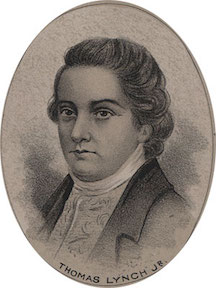
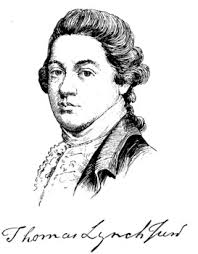 Thomas Lynch, Sr., was married to Elizabeth Allston, of Brookgreen Plantation, another Georgetown prominent and wealthy family, and they had daughters Sabina (b.1747) and Esther (b.1748) and one son, Thomas Jr. (b.1749). After Elizabeth Allston died (c.1755), Mr. Lynch Sr. married Hannah Motte, and they had a daughter, Elizabeth (b.1755).
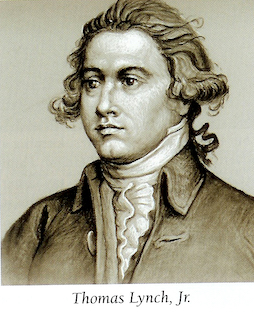 He soon after married, on May 13, 1772, a beautiful young lady he had known since childhood, Elizabeth Shubrick, daughter of Thomas and Mary Baker Shubrick, of Charleston, SC. They had no children. Interestingly, Elizabeth’s sister, Mary, married Edward Rutledge, and her sister, Hannah, married William Heyward, brother of Thomas Heyward, Jr. Rutledge and Thomas Heyward, Jr., were also signers of the Declaration. Thomas Jr. quickly became much sought after for public service, becoming a member of the colony’s first and second Provincial Congress (1774-1776) and the Constitutional Committee for South Carolina, where he helped draft the state constitution.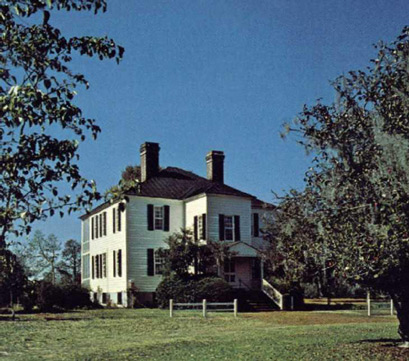
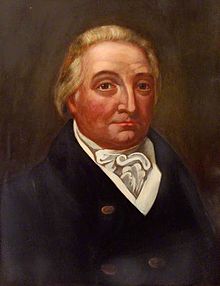
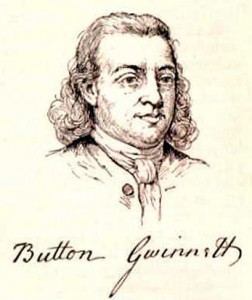
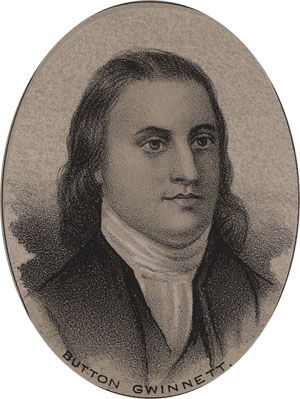 Disappointed in his military ambitions, Gwinnett continued to lead the opposition to the Christ Church Parish coalition, and when his followers gained control of Georgia’s Provincial Congress, they succeeded in electing him Speaker. He played a key role in the passage of the Georgia Constitution of 1777 and began to purge the military of officers whom he and his followers deemed less than zealous in their enthusiasm for the Whig cause. This brought him into conflict with Lachlan McIntosh. After the death of Georgia’s president and commander-in-chief, Archibald Bulloch, in February 1777, the Council of Safety appointed Gwinnett to succeed him.
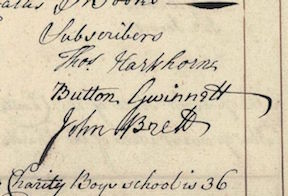 Gwinnett’s signature is one of the rarest and most valuable of the signers of the Declaration of Independence. In 1979 a letter signed by Gwinnett brought $100,000 at a New York auction; its value was estimated in 1983 to be up to $250,000.



 Every Woman Dreams...